Intercalation in Layered Materials
Intercalation is a reversible insertion of mobile atomic
or molecular guest species into a solid host lattice
Intercalation compounds are hybrid systems between solids
and fluids
Most visible effect: Host lattice expansion
- Host intralayer structure remains unchanged
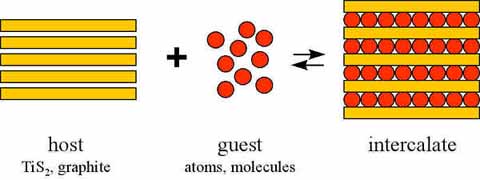
Strong bonding WITHIN layers (covalent)
Weak bonding BETWEEN layers (‘galleries’,
‘van der Waals gaps’)
- Intercalation leads to a broad spectrum of compounds
- Most important classes:
transition-metal dichalcogenide IC’s (TMDIC’s)
graphite IC’s (GIC’s)
- Variety of unusual chemical and physical properties
superconductivity, charge density waves, anisotropic
electrical conductivity, redox reactions, structural transitions, superstructures
- Ideal arena for studying physical phenomena in 1 and 2
dimensions
- Phenomenal synthetic flexibility
- Controlled modification of physical properties of solids
- Low temperature pathway to synthesize new materials
- Alternative for thin-film superlattices
- Applications:
battery electrodes, electrochemic displays, catalysis, dry
lubricants, and sensor systems