High-Resolution Electron Microscopy of Intercalation
Compounds
With regard to intercalation compounds, high resolution electron microscopy is able to
provide valuable information on the structural organization of these materials and, hence,
can help to solve many of the unresolved issues in intercalation chemistry. For example,
conventional HRTEM has already provided the most direct support for the Daumas-Hrold
model of staging by direct imaging of D-H domain boundaries, coherent stage-n regions, and
guest islands.
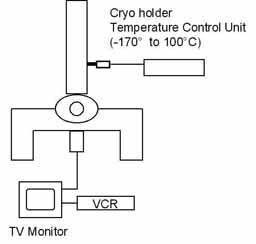 However,
such static observations are inherently limited in the information they can provide on
intercalation/deintercalation reaction processes, staging transitions and dynamics. In
contrast to these static observations, the potential of recently developed dynamic high resolution transmission electron microscopy (DHRTEM)
to explore these processes at the atomic level is tremendous.
However,
such static observations are inherently limited in the information they can provide on
intercalation/deintercalation reaction processes, staging transitions and dynamics. In
contrast to these static observations, the potential of recently developed dynamic high resolution transmission electron microscopy (DHRTEM)
to explore these processes at the atomic level is tremendous.
DHRTEM provides a unique and powerful tool for investigating staging processes and
related phenomena in layered ICs at the atomic level. Indeed, it is the only technique
that allows direct atomic-level imaging of both guest and host layers during staging
transformations. Very recently, environmental DHRTEM has been employed to observe
intercalation reaction processes at the atomic level for the first time. DHRTEM has also
been used to make the first atomic-level observations of staging processes associated with
model ionic Ag+0.17TiS20.17- [67] and neutral Hg1.24TiS2
[67,68] intercalation compounds. In these studies, it has been shown that such dynamic
studies can directly resolve reaction processes and their associated cause-and-effect
relationships. The results of these initial efforts with DHRTEM to investigate
intercalation mechanisms are summarized below.